X의 Ray Dalio님(@RayDalio)
It’s Official: The World Order Has Broken Down
x.com
About the Author: Ray Dalio
Ray Dalio is an American investor and macroeconomic strategist, best known as the founder of Bridgewater Associates, one of the largest and most influential hedge funds in the world. He founded Bridgewater in 1975 and built it into a global macro investment firm recognized for its systematic, research-driven approach to markets.
Beyond his role as an investor, Dalio is widely known for his analysis of long-term economic and historical cycles. He argues that nations rise and decline according to recurring patterns driven by debt dynamics, productivity, internal political cohesion, military strength, and currency dominance. He refers to this framework as the “Big Cycle.”
In his book Principles for Dealing with the Changing World Order, Dalio examines 500 years of global power shifts—including the Dutch, British, and American empires—to draw parallels with today’s geopolitical landscape, particularly the evolving rivalry between the United States and China. His earlier work, Principles, outlines the decision-making principles and organizational philosophy that guided Bridgewater’s culture.
Dalio’s writing is distinguished by its integration of investment experience with macroeconomic and historical analysis. In the present essay, he applies his long-term cyclical framework to interpret what he sees as the breakdown of the post-1945 world order and the transition toward a new phase of great power competition.
이 글의 저자인 레이 달리오는 미국의 투자자이자 거시경제 전략가로, 세계 최대 헤지펀드 중 하나인 Bridgewater Associates의 창립자이다. 그는 1975년 브리지워터를 설립한 이후 글로벌 매크로 투자 전략을 통해 국제 금융시장에서 큰 영향력을 행사해 왔다.
달리오는 단순한 투자자를 넘어, 경제와 역사에서 반복되는 ‘사이클(cycle)’을 분석하는 사상가로도 알려져 있다. 그는 국가의 흥망이 부채, 생산성, 내부 갈등, 군사력, 통화 패권 등의 요소에 의해 장기적으로 반복된다고 보며, 이를 ‘Big Cycle(대순환)’ 이론으로 체계화했다.
그의 대표 저서인 Principles for Dealing with the Changing World Order에서는 지난 500년간 네덜란드, 영국, 미국 등의 패권 변화를 분석하며, 오늘날 미국과 중국의 경쟁 구도를 역사적 맥락 속에서 해석한다. 또한 Principles에서는 개인과 조직의 의사결정을 위한 ‘원칙’ 중심 사고를 제시하며 경영철학을 정리했다.
달리오의 글은 경제학 이론보다는 투자 실무 경험에 기반한 거시적 통찰을 특징으로 한다. 특히 부채 위기, 통화 체제 변화, 패권 경쟁, 내부 정치적 분열이 어떻게 맞물려 세계 질서를 재편하는지를 분석하는 데 초점을 둔다.
이 글 역시 그러한 그의 역사·거시경제적 관점에서, 전후(1945년 이후) 세계 질서의 붕괴와 새로운 국제 질서로의 전환 가능성을 설명하는 맥락에서 이해할 수 있다.
It’s Official: The World Order Has Broken Down
“세계 질서 붕괴” 진술의 맥락
달리오가 최신 의견에서 세계 질서가 붕괴됐다고 표현한 것은 그의 해석이며, 국제 정치학이나 국제법적 “질서 붕괴” 개념과 정확히 동일한 것은 아니다 — 이는 그의 Big Cycle 프레임 안에서의 진단이다.
At the Munich Security Conference, the post-1945 world order was pronounced dead by most leaders and the picture behind it was laid out in the Security Report 2026, entitled “Under Destruction,” which you can read
if you're interested. More specifically, German Chancellor Friedrich Merz said, “The world order as it has stood for decades no longer exists,” and that we are in a period “great power politics.” He made clear that freedom “is no longer a given” in this new era. French President Emmanuel Macron echoed Merz’s assessment and said that Europe’s old security structures tied to the previous world order don't exist and that Europe must prepare for war. U.S. Secretary of State Marco Rubio said that we are in a “new geopolitics era” because the “old world” is gone.
In my parlance, we are in the Stage 6 part of the Big Cycle in which there is great disorder arising from being in a period in which there are no rules, might is right, and there is a clash of great powers. How Stage 6 works is explained in detail in Chapter 6, “The Big Cycle of External Order and Disorder,” in my book Principles for Dealing with the Changing World Order. While I previously shared a lengthy set of excerpts from Chapter 5 ("The Big Cycle of Internal Order and Disorder"), so you could see how what is going on with the United States tracks the classic cycle explained in that chapter, I am including all of Chapter 6 here for your review. Given the now nearly universal agreement that the post-1945 world order has broken down and that we are entering a new world order, I think it would be worth your time to read.
뮌헨안보회의에서, 1945년 이후의 세계질서는 대부분의 지도자들에 의해 죽었다고 선언되었고, 그 배경 그림은 “Under Destruction”이라는 제목의 Security Report 2026에 제시되어 있는데, 관심이 있다면 여기에서 읽을 수 있다. 더 구체적으로, 독일 총리 프리드리히 메르츠는 “수십 년 동안 존재해 온 세계질서는 더 이상 존재하지 않는다”고 말했고, 우리가 “강대국 정치”의 시기에 있다고 말했다. 그는 이 새로운 시대에 자유가 “더 이상 당연한 것으로 주어지는 것이 아니다”라는 점을 분명히 했다. 프랑스 대통령 에마뉘엘 마크롱은 메르츠의 평가에 공명했고, 이전 세계질서에 묶여 있던 유럽의 오래된 안보 구조들은 존재하지 않으며 유럽은 전쟁을 준비해야 한다고 말했다. 미국 국무장관 마르코 루비오는 “옛 세계”가 사라졌기 때문에 우리가 “새로운 지정학 시대”에 있다고 말했다.
내 용어로 말하면, 우리는 빅 사이클의 6단계(Stage 6) 부분에 있는데, 이는 규칙이 없는 시기, 힘이 곧 정의인 시기, 그리고 강대국들의 충돌이 있는 시기에 들어와서 발생하는 거대한 무질서가 존재하는 단계다. Stage 6가 어떻게 작동하는지는 내 책 Principles for Dealing with the Changing World Order의 6장 “외부 질서와 무질서의 빅 사이클(The Big Cycle of External Order and Disorder)”에서 자세히 설명되어 있다. 내가 이전에 5장(“내부 질서와 무질서의 빅 사이클”)에서 긴 발췌문 묶음을 공유했던 것은, 미국에서 벌어지고 있는 일이 그 장에서 설명된 고전적 사이클을 어떻게 따라가는지 당신이 볼 수 있도록 하기 위해서였는데, 나는 여기에서 당신이 검토할 수 있도록 6장 전체를 포함한다. 이제 1945년 이후의 세계질서가 붕괴했고 우리가 새로운 세계질서로 들어가고 있다는 데 거의 보편적 합의가 형성된 것을 고려하면, 읽는 데 당신의 시간을 들일 가치가 있을 것이라고 나는 생각한다.
Chapter 6: The Big Cycle of External Order and Disorder
Relationships between people and the orders that govern them work in basically the same ways, whether they are internal or external, and they blend together. In fact, it wasn’t long ago that there were no distinctions between internal and external orders because there were no clearly defined and mutually recognized boundaries between countries. For that reason, the six-stage cycle of going between order and disorder that I described in the last chapter about what happens within countries works the same way between countries, with one big exception: international relations are driven much more by raw power dynamics. That is because all governance systems require effective and agreed-upon 1) laws and law-making abilities, 2) law enforcement capabilities (e.g., police), 3) ways of adjudicating (e.g., judges), and 4) clear and specified consequences that both suit crimes and are enforced (e.g., fines and incarcerations), and those things either don’t exist or are not as effective in guiding relations between countries as they are in guiding relations within them.
While attempts have been made to make the external order more rule-abiding (e.g., via the League of Nations and the United Nations), by and large they have failed because these organizations have not had more wealth and power than the most powerful countries. When individual countries have more power than the collectives of countries, the more powerful individual countries rule. For example, if the US, China, or other countries have more power than the United Nations, then the US, China, or other countries will determine how things go rather than the United Nations. That is because power prevails, and wealth and power among equals is rarely given up without a fight.
When powerful countries have disputes, they don’t get their lawyers to plead their cases to judges. Instead, they threaten each other and either reach agreements or fight. The international order follows the law of the jungle much more than it follows international law.
제6장: 외부 질서와 무질서의 빅 사이클
사람들 사이의 관계와 그들을 지배하는 질서들은 그것이 내부적이든 외부적이든 기본적으로 같은 방식으로 작동하며, 서로 뒤섞여 있다. 사실, 그리 오래전까지도 내부 질서와 외부 질서를 구분하는 명확한 구분은 존재하지 않았는데, 이는 국가들 사이에 명확하게 정의되고 상호 인정된 경계가 없었기 때문이다. 그런 이유로, 내가 지난 장에서 국가 내부에서 일어나는 일에 대해 설명한 질서와 무질서 사이를 오가는 6단계 사이클은 국가들 사이에서도 동일하게 작동한다. 단 하나의 큰 예외가 있다면, 국제관계는 훨씬 더 노골적인 힘의 역학에 의해 움직인다는 점이다. 이는 모든 통치 체계가 효과적이고 합의된 1) 법과 법을 제정하는 능력, 2) 법 집행 능력(예: 경찰), 3) 재판을 통해 판단하는 방식(예: 판사), 4) 범죄에 상응하면서도 실제로 집행되는 명확하고 구체적인 결과(예: 벌금과 구금)를 필요로 하기 때문인데, 그러한 것들은 국가 간 관계를 이끄는 데 있어 국가 내부 관계를 이끄는 것만큼 존재하지 않거나 효과적으로 작동하지 않는다.
외부 질서를 보다 규칙 준수적으로 만들기 위한 시도들(예: 국제연맹과 국제연합을 통한 시도)이 있었지만, 대체로 실패해왔다. 그 이유는 이러한 조직들이 가장 강력한 국가들보다 더 많은 부와 권력을 갖지 못했기 때문이다. 개별 국가들이 국가 집단보다 더 큰 힘을 가질 때에는, 더 강력한 개별 국가가 지배한다. 예를 들어, 미국, 중국 또는 다른 국가들이 국제연합보다 더 큰 힘을 가진다면, 사안이 어떻게 전개될지는 국제연합이 아니라 미국, 중국 또는 다른 국가들에 의해 결정된다. 이는 힘이 우위를 차지하기 때문이며, 동등한 자들 사이에서의 부와 권력은 싸움 없이 거의 양보되지 않기 때문이다.
강력한 국가들 사이에 분쟁이 발생하면, 그들은 변호사를 보내 판사 앞에서 사건을 변론하게 하지 않는다. 대신 서로를 위협하고, 합의에 도달하거나 아니면 싸운다. 국제질서는 국제법을 따르기보다는 정글의 법칙을 훨씬 더 많이 따른다.
There are five major kinds of fights between countries: trade/economic wars, technology wars, capital wars, geopolitical wars, and military wars. Let’s begin by briefly defining them.
1. Trade/economic wars: Conflicts over tariffs, import/export restrictions, and other ways of damaging a rival economically
2. Technology wars: Conflicts over which technologies are shared and which are held as protected aspects of national security
3. Geopolitical wars: Conflicts over territory and alliances that are resolved through negotiations and explicit or implicit commitments, not fighting
4. Capital wars: Conflicts imposed through financial tools such as sanctions (e.g., cutting off money and credit by punishing institutions and governments that offer it) and limiting foreign access to capital markets
5. Military wars: Conflicts that involve actual shooting and the deployment of military forces
Most fights between nations fall under one or more of those categories (cyber warfare, for example, has a role in all of them). They are over wealth and power and the ideologies pertaining to them.
While most of these types of wars don’t involve shooting and killing, they all are power struggles. In most cases, the first four kinds of war will evolve over time as intense competitions between rival nations until a military war begins. These struggles and wars, whether or not they involve shooting and killing, are exertions of power of one side over the other. They can be all-out or contained, depending on how important the issue is and what the relative powers of the opponents are. But once a military war begins, all four of the other dimensions will be weaponized to the greatest extent possible.
As discussed in the last several chapters, all of the factors that drive internal and external cycles tend to improve and worsen together. When things get bad, there are more things to argue over, which leads to greater inclinations to fight. That’s human nature, and it is why we have the Big Cycle, which oscillates between good times and bad ones.
- All-out wars typically occur when existential issues (ones that are so essential to the country’s existence that people are willing to fight and die for them) are at stake and they cannot be resolved by peaceful means. The wars that result from them make it clear which side gets its way and has supremacy in subsequent matters. That clarity over who sets the rules then becomes the basis of a new international order.
The following chart shows the cycles of internal and external peace and conflict in Europe going back to 1500 as reflected in the deaths they caused. As you can see, there were three big cycles of rising and declining conflict, averaging about 150 years each. Though big civil and external wars last only a short time, they are typically the culmination of the longstanding conflicts that led up to them.
While World Wars I and II were separately driven by the classic cycle, they were also interrelated.
국가들 사이에는 다섯 가지 주요한 싸움의 형태가 있다: 무역/경제 전쟁, 기술 전쟁, 자본 전쟁, 지정학 전쟁, 그리고 군사 전쟁. 그것들을 간단히 정의하는 것부터 시작해 보자.
- 무역/경제 전쟁: 관세, 수입/수출 제한, 그리고 경쟁국에 경제적으로 피해를 입히는 기타 방식들을 둘러싼 갈등
- 기술 전쟁: 어떤 기술을 공유할 것인지, 그리고 어떤 기술을 국가 안보의 보호 대상 요소로 유지할 것인지를 둘러싼 갈등
- 지정학 전쟁: 영토와 동맹을 둘러싼 갈등으로, 싸움을 통해서가 아니라 협상과 명시적 또는 묵시적 약속을 통해 해결되는 갈등
- 자본 전쟁: 제재와 같은 금융 수단(예: 자금을 제공하는 기관이나 정부를 처벌함으로써 자금과 신용을 차단하는 것)이나 외국의 자본시장 접근을 제한하는 방식으로 가해지는 갈등
- 군사 전쟁: 실제 총격과 군 병력의 배치를 수반하는 갈등
국가들 사이의 대부분의 싸움은 이러한 범주 중 하나 이상에 속한다(예를 들어 사이버 전쟁은 이 모든 범주에 역할을 한다). 그것들은 부와 권력, 그리고 그에 관련된 이념을 둘러싼 싸움이다.
이러한 유형의 전쟁들 대부분은 총격과 살상을 수반하지 않지만, 그것들 모두는 권력 투쟁이다. 대부분의 경우, 처음 네 가지 유형의 전쟁은 군사 전쟁이 시작될 때까지 경쟁 국가들 사이의 격렬한 경쟁으로 시간이 지나면서 발전한다. 이러한 투쟁과 전쟁은 총격과 살상을 수반하든 그렇지 않든, 한쪽이 다른 쪽에 대해 권력을 행사하는 행위들이다. 그것들은 쟁점이 얼마나 중요한지, 그리고 상대 세력들의 상대적 힘이 어떠한지에 따라 전면적일 수도 있고 제한적일 수도 있다. 그러나 일단 군사 전쟁이 시작되면, 다른 네 가지 차원 모두는 가능한 최대한으로 무기화된다.
앞의 여러 장에서 논의했듯이, 내부 및 외부 사이클을 움직이는 모든 요인들은 함께 개선되기도 하고 함께 악화되기도 하는 경향이 있다. 상황이 나빠지면 다툴 사안이 더 많아지고, 이는 싸우려는 성향을 더 크게 만든다. 그것이 인간의 본성이며, 그래서 우리는 좋은 시기와 나쁜 시기 사이를 오가는 빅 사이클을 갖게 된다.
전면전은 보통 존립적 문제들(국가의 존재에 너무나 본질적이어서 사람들이 그것을 위해 기꺼이 싸우고 죽으려 하는 사안들)이 걸려 있고, 그것이 평화적 수단으로 해결될 수 없을 때 발생한다. 그로부터 발생하는 전쟁은 어느 쪽이 자신의 뜻을 관철하고 이후의 사안들에서 우위를 갖는지를 분명히 한다. 누가 규칙을 정하는지에 대한 그 명확성은 새로운 국제 질서의 기초가 된다.
다음 도표는 1500년까지 거슬러 올라가 유럽에서 발생한 내부 및 외부의 평화와 갈등의 사이클을, 그것들이 초래한 사망자 수를 통해 보여준다. 보시다시피, 갈등이 상승했다가 하강하는 세 번의 큰 사이클이 있었으며, 각각 평균 약 150년 정도 지속되었다. 거대한 내전과 대외전쟁은 비교적 짧은 기간만 지속되지만, 그것들은 대개 그에 앞서 오랫동안 축적되어 온 갈등의 정점이다.
제1차 세계대전과 제2차 세계대전은 각각 고전적 사이클에 의해 별도로 움직였지만, 동시에 서로 연관되어 있었다.
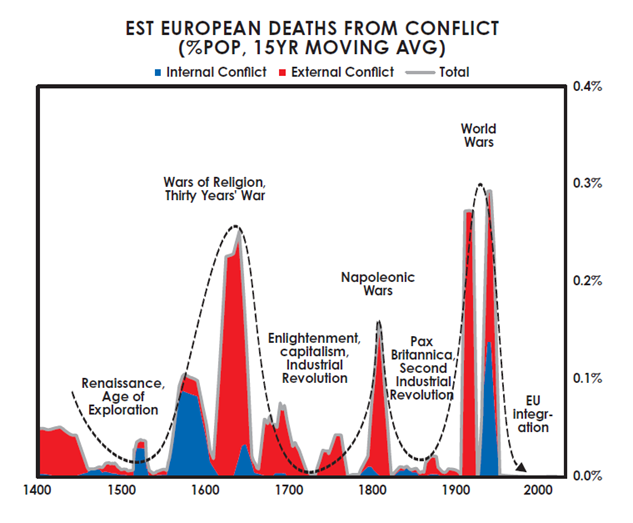
As you can see, each cycle consisted of a relatively long period of peace and prosperity (e.g., the Renaissance, the Enlightenment, and the Industrial Revolution) that sowed the seeds for terrible and violent external wars (e.g., the Thirty Years’ War, the Napoleonic Wars, and the two World Wars). Both the upswings (the periods of peace and prosperity) and the downswings (the periods of depression and war) affected the whole world. Not all countries prosper when the leading powers do because countries gain at the expense of others. For example, the decline of China from around 1840 to 1949, known as the “Century of Humiliation,” came about because the Western powers and Japan exploited China.
As you read on, keep in mind that * the two things about war that one can be most confident in are 1) that it won’t go as planned and 2) that it will be far worse than imagined. It is for those reasons that so many of the principles that follow are about ways to avoid shooting wars. Still, whether they are fought for good reasons or bad, shooting wars happen. To be clear, while I believe most are tragic and fought for nonsensical reasons, some are worth fighting because the consequences of not fighting them (e.g., the loss of freedom) would be intolerable.
보시다시피, 각 사이클은 비교적 긴 평화와 번영의 시기(예: 르네상스, 계몽주의, 산업혁명)로 구성되어 있었으며, 그러한 시기들은 끔찍하고 폭력적인 대외전쟁(예: 30년 전쟁, 나폴레옹 전쟁, 두 차례의 세계대전)의 씨앗을 뿌렸다. 상승 국면(평화와 번영의 시기)과 하강 국면(공황과 전쟁의 시기) 모두 전 세계에 영향을 미쳤다. 선도 강대국이 번영할 때 모든 국가가 함께 번영하는 것은 아니다. 왜냐하면 국가들은 다른 국가들의 희생을 대가로 이득을 얻기 때문이다. 예를 들어, 1840년경부터 1949년까지 이어진 중국의 쇠퇴, 이른바 “굴욕의 세기”는 서구 열강과 일본이 중국을 착취했기 때문에 발생했다.
계속 읽어가면서 다음을 명심하라. 전쟁에 대해 우리가 가장 확신할 수 있는 두 가지는 1) 그것이 계획대로 진행되지 않을 것이라는 점, 2) 그것이 상상했던 것보다 훨씬 더 끔찍해질 것이라는 점이다. 바로 그러한 이유들 때문에, 뒤에 이어지는 많은 원칙들은 실제 총격이 수반되는 전쟁을 피하는 방법에 관한 것이다. 그럼에도 불구하고, 그것들이 좋은 이유로 싸워지든 나쁜 이유로 싸워지든, 총격전은 발생한다. 분명히 말하자면, 나는 대부분의 전쟁이 비극적이며 터무니없는 이유로 벌어진다고 믿지만, 어떤 전쟁들은 싸울 가치가 있다. 왜냐하면 그것들을 싸우지 않았을 때의 결과(예: 자유의 상실)가 도저히 감내할 수 없을 것이기 때문이다.
THE TIMELESS AND UNIVERSAL FORCES THAT PRODUCE CHANGES TO THE EXTERNAL ORDER
As I explained in Chapter 2, after self-interest and self-survival, the quest for wealth and power is what most motivates individuals, families, companies, states, and countries. Because wealth equals power in terms of the ability to build military strength, control trade, and influence other nations, domestic and military strength go hand in hand. It takes money to buy guns (military power) and it takes money to buy butter (domestic social spending needs). When a country fails to provide adequate amounts of either, it becomes vulnerable to domestic and foreign opposition. From my study of Chinese dynasties and European empires, I’ve learned that the financial strength to outspend one’s rivals is one of the most important strengths a country can have. That is how the United States beat the Soviet Union in the Cold War. Spend enough money in the right ways, and you don’t have to have a shooting war. Long-term success depends on sustaining both the “guns” and the “butter” without producing the excesses that lead to their declines. In other words, a country must be strong enough financially to give its people both a good living standard and protection from outside enemies. The really successful countries have been able to do that for 200 to 300 years. None has been able to do it forever.
Conflict arises when the dominant power begins to weaken or an emerging power begins to approach it in strength—or both. * The greatest risk of military war is when both parties have 1) military powers that are roughly comparable and 2) irreconcilable and existential differences. As of this writing, the most potentially explosive conflict is that between the United States and China over Taiwan.
The choice that opposing countries face—either fighting or backing down—is very hard to make. Both are costly—fighting in terms of lives and money, and backing down in terms of the loss of status, since it shows weakness, which leads to reduced support. When two competing entities each have the power to destroy the other, both must have extremely high trust that they won’t be unacceptably harmed or killed by the other. Managing the prisoner’s dilemma well, however, is extremely rare.
While there are no rules in international relations other than those the most powerful impose on themselves, some approaches produce better outcomes than others. Specifically, those that are more likely to lead to win-win outcomes are better than those that lead to lose-lose outcomes. Hence this all-important principle: * to get more win-win outcomes one needs to negotiate with consideration given to what is most important to the other party and to oneself and know how to trade them.
Skilled collaborations to produce win-win relationships that both increase and divide up wealth and power well are much more rewarding and much less painful than wars that lead to one side subjugating the other. Seeing things through your adversary’s eyes and clearly identifying and communicating your red lines to them (i.e., what cannot be compromised) are the keys to doing this well. * Winning means getting the things that are most important without losing the things that are most important, so wars that cost much more in lives and money than they provide in benefits are stupid. But “stupid” wars still happen all the time for reasons that I will explain.
It is far too easy to slip into stupid wars because of a) the prisoner’s dilemma, b) a tit-for-tat escalation process, c) the perceived costs of backing down for the declining power, and d) misunderstandings existing when decision making has to be fast. Rival great powers typically find themselves in the prisoner’s dilemma; they need to have ways of assuring the other that they won’t try to kill them lest the other tries to kill them first. Tit-for-tat escalations are dangerous in that they require each side to escalate or lose what the enemy captured in the last move; it is like a game of chicken—push it too far and there is a head-on crash.
Untruthful and emotional appeals that rile people up increase the dangers of stupid wars, so it is better for leaders to be truthful and thoughtful in explaining the situation and how they are dealing with it (this is especially essential in a democracy, in which the opinions of the population matter). The worst thing is when leaders are untruthful and emotional in dealing with their populations, and it is worse still when they take over the media.
By and large, the tendency to move between win-win relationships and lose-lose relationships happens in a cyclical way. People and empires are more likely to have cooperative relationships during good times and to fight during bad times. When the existing great power is declining in relation to a rising power, it has a natural tendency to want to maintain the status quo or the existing rules, while the rising power wants to change them to be in line with the changing facts on the ground.
While I don’t know about the love part of the saying “all is fair in love and war,” I know the war part is right. As an example, in the American Revolutionary War, when the British lined up in rows for the fight and the American revolutionaries shot at them from behind trees, the British thought that was unfair and complained. The revolutionaries won believing the British were foolish and that the cause of independence and freedom justified changing the rules of war. That’s just how it is.
외부 질서의 변화를 만들어내는 시대를 초월하고 보편적인 힘들
2장에서 설명했듯이, 자기이익과 자기생존 다음으로, 부와 권력을 추구하는 욕망이 개인, 가족, 기업, 주(州), 그리고 국가를 가장 크게 움직이는 동기이다. 군사력을 구축하고, 무역을 통제하며, 다른 국가들에 영향력을 행사할 수 있는 능력이라는 점에서 부는 곧 권력이기 때문에, 국내 역량과 군사적 역량은 서로 맞물려 간다. 총(군사력)을 사는 데에도 돈이 필요하고, 버터(국내 사회적 지출 수요)를 사는 데에도 돈이 필요하다. 어느 한쪽이든 충분히 제공하지 못하면, 그 국가는 국내 및 해외의 반대 세력에 취약해진다. 중국 왕조들과 유럽 제국들을 연구하면서 내가 배운 것은, 경쟁자들보다 더 많이 지출할 수 있는 재정적 역량이 국가가 가질 수 있는 가장 중요한 강점 중 하나라는 점이다. 미국이 냉전에서 소련을 이긴 것도 바로 그런 방식이었다. 적절한 방식으로 충분한 돈을 쓰면, 반드시 총격전을 치르지 않아도 된다. 장기적인 성공은 “총”과 “버터”를 모두 유지하되, 그것들의 쇠퇴를 초래하는 과잉을 만들어내지 않는 데 달려 있다. 다시 말해, 한 국가는 자국민에게 좋은 생활수준과 외부의 적으로부터의 보호를 동시에 제공할 수 있을 만큼 재정적으로 충분히 강해야 한다. 정말로 성공한 국가들은 그것을 200년에서 300년 동안 해낼 수 있었다. 그러나 영원히 해낸 국가는 없다.
갈등은 지배적 강대국이 약해지기 시작하거나, 신흥 강대국이 그에 필적할 만큼 힘을 갖기 시작할 때—또는 그 두 가지가 동시에 일어날 때—발생한다. 군사 전쟁의 위험이 가장 클 때는 양측이 1) 대략적으로 비슷한 군사력을 가지고 있고, 2) 타협할 수 없으며 존립과 관련된 차이를 가지고 있을 때이다. 이 글을 쓰는 시점에서 가장 폭발 가능성이 큰 갈등은 대만을 둘러싼 미국과 중국 사이의 갈등이다.
서로 대립하는 국가들이 직면하는 선택—싸울 것인가, 아니면 물러설 것인가—은 매우 어렵다. 둘 다 비용이 크다. 싸우는 것은 생명과 돈의 측면에서 비용이 크고, 물러서는 것은 지위의 상실이라는 측면에서 비용이 크다. 왜냐하면 그것은 약함을 드러내며, 이는 지지의 감소로 이어지기 때문이다. 서로를 파괴할 수 있는 힘을 가진 두 경쟁 주체가 있을 때, 양측 모두 상대가 자신을 용납할 수 없을 정도로 해치거나 죽이지 않을 것이라는 극히 높은 신뢰를 가져야 한다. 그러나 죄수의 딜레마를 잘 관리하는 일은 극히 드물다.
국제 관계에는 가장 강력한 자들이 스스로에게 부과하는 규칙 외에는 다른 규칙이 존재하지 않지만, 어떤 접근 방식은 다른 것들보다 더 나은 결과를 낳는다. 구체적으로 말해, 윈-윈 결과로 이어질 가능성이 더 높은 접근 방식이 루즈-루즈 결과로 이어지는 접근 방식보다 낫다. 따라서 다음과 같은 매우 중요한 원칙이 있다. 더 많은 윈-윈 결과를 얻기 위해서는, 상대방과 자신에게 무엇이 가장 중요한지를 고려하여 협상하고, 그것들을 어떻게 교환할지를 알아야 한다.
부와 권력을 함께 늘리고 잘 나누는 윈-윈 관계를 만들어내는 숙련된 협력은, 한쪽이 다른 쪽을 종속시키는 전쟁보다 훨씬 더 보람 있고 훨씬 덜 고통스럽다. 상대의 눈을 통해 사안을 보고, 자신의 레드라인(즉, 타협할 수 없는 것들)을 명확히 식별하고 전달하는 것이 이를 잘 해내는 핵심이다. 이긴다는 것은 가장 중요한 것들을 얻으면서 동시에 가장 중요한 것들을 잃지 않는 것을 의미한다. 따라서 생명과 돈의 비용이 그로 인해 얻는 이익보다 훨씬 더 큰 전쟁은 어리석다. 그러나 “어리석은” 전쟁은 내가 설명하겠지만 여전히 항상 발생한다.
어리석은 전쟁으로 미끄러져 들어가는 것은 너무나 쉽다. 그 이유는 a) 죄수의 딜레마, b) 맞대응식(tit-for-tat) 에스컬레이션 과정, c) 쇠퇴하는 강대국이 물러서는 데 따르는 인지된 비용, d) 빠른 의사결정이 요구되는 상황에서 발생하는 오해 때문이다. 경쟁하는 강대국들은 대개 죄수의 딜레마 상황에 놓인다. 상대가 먼저 자신을 죽이려 하지 않도록 하기 위해, 상대가 자신을 죽이려 하지 않을 것이라는 보장 방식을 가져야 한다. 맞대응식 에스컬레이션은 위험하다. 왜냐하면 각 측이 상대가 직전에 차지한 것을 되찾지 않으면 안 되기 때문에 계속 수위를 높여야 하기 때문이다. 그것은 치킨게임과 같아서, 너무 멀리 밀어붙이면 정면충돌이 일어난다.
사람들을 선동하는 거짓되고 감정적인 호소는 어리석은 전쟁의 위험을 증가시킨다. 따라서 지도자들이 상황과 자신들이 어떻게 그것을 다루고 있는지를 정직하고 신중하게 설명하는 것이 더 낫다(특히 대중의 의견이 중요한 민주주의에서는 더욱 그렇다). 최악의 경우는 지도자들이 국민을 대할 때 거짓되고 감정적인 태도를 취하는 것이며, 언론을 장악할 때는 그보다 더 나쁘다.
대체로 윈-윈 관계와 루즈-루즈 관계 사이를 오가는 경향은 순환적인 방식으로 일어난다. 사람들과 제국들은 좋은 시기에는 협력적 관계를 맺을 가능성이 더 높고, 나쁜 시기에는 싸울 가능성이 더 높다. 기존의 강대국이 신흥 강대국에 비해 쇠퇴하고 있을 때, 기존 강대국은 현상 유지 또는 기존 규칙을 유지하려는 자연스러운 성향을 가지며, 반대로 신흥 강대국은 변화된 현실에 맞게 규칙을 바꾸려는 성향을 가진다.
“사랑과 전쟁에서는 모든 것이 정당하다”는 말에서 사랑 부분에 대해서는 잘 모르겠지만, 전쟁 부분이 맞다는 것은 안다. 예를 들어, 미국 독립전쟁에서 영국군이 전투를 위해 줄지어 섰을 때 미국 혁명군이 나무 뒤에서 그들을 향해 사격하자, 영국은 그것이 불공정하다고 생각하고 불평했다. 혁명군은 영국이 어리석다고 믿었고, 독립과 자유라는 대의가 전쟁의 규칙을 바꾸는 것을 정당화한다고 믿으며 승리했다. 세상은 그런 식으로 돌아간다.
This leads me to one final principle: * have power, respect power, and use power wisely. Having power is good because power will win out over agreements, rules, and laws all the time. When push comes to shove, those who have the power to either enforce their interpretation of the rules and laws or to overturn them will get what they want. It is important to respect power because it’s not smart to fight a war that one is going to lose; it is preferable to negotiate the best settlement possible (that is unless one wants to be a martyr, which is usually for stupid ego reasons rather than for sensible strategic reasons). It is also important to use power wisely. Using power wisely doesn’t necessarily mean forcing others to give you what you want—i.e., bullying them. It includes the recognition that generosity and trust are powerful forces for producing win-win relationships, which are fabulously more rewarding than lose-lose relationships. In other words, it is often the case that using one’s “hard powers” is not the best path and that using one’s “soft powers” is preferable.
When thinking about how to use power wisely, it’s also important to decide when to reach an agreement and when to fight. To do that, a party must imagine how its power will change over time. It is desirable to use one’s power to negotiate an agreement, enforce an agreement, or fight a war when one’s power is greatest. That means that it pays to fight early if one’s relative power is declining and fight later if it’s rising.
If one is in a lose-lose relationship, one has to get out of it one way or another, preferably through separation, though possibly through war. To handle one’s power wisely, it’s usually best not to show it because it will usually lead others to feel threatened and build their own threatening powers, which will lead to a mutual escalation that threatens both. Power is usually best handled like a hidden knife that can be brought out in the event of a fight. But there are times when showing one’s power and threatening to use it are most effective for improving one’s negotiating position and preventing a fight. Knowing what matters most and least to the other party, especially what they will and won’t fight for, allows you to work your way toward an equilibrium that both parties consider a fair resolution of a dispute.
Though it is generally desirable to have power, it is also desirable to not have power that one doesn’t need. That is because maintaining power consumes resources, most importantly your time and your money. Also, with power comes the burden of responsibilities. I have often been struck by how much happier less powerful people can be relative to more powerful people.
이것은 나를 하나의 마지막 원칙으로 이끈다. 힘을 가져라, 힘을 존중하라, 그리고 힘을 현명하게 사용하라. 힘을 가지는 것은 좋다. 왜냐하면 힘은 항상 합의, 규칙, 그리고 법을 이기기 때문이다. 막상 상황이 극단으로 몰리면, 규칙과 법에 대한 자신의 해석을 강제할 수 있는 힘을 가지거나 그것들을 뒤집을 수 있는 힘을 가진 자가 자신이 원하는 것을 얻게 된다. 힘을 존중하는 것은 중요하다. 왜냐하면 자신이 질 것이 분명한 전쟁을 치르는 것은 현명하지 않기 때문이다. 가능한 한 최선의 합의를 협상하는 것이 바람직하다(순교자가 되기를 원하는 경우는 예외인데, 그것은 대개 합리적인 전략적 이유라기보다 어리석은 자존심 때문인 경우가 많다). 또한 힘을 현명하게 사용하는 것도 중요하다. 힘을 현명하게 사용한다는 것은 반드시 다른 사람들에게 자신이 원하는 것을 강제로 내놓게 만드는 것—즉, 괴롭히는 것—을 의미하지는 않는다. 그것은 관대함과 신뢰가 윈-윈 관계를 만들어내는 강력한 힘이라는 점을 인식하는 것을 포함한다. 그러한 관계는 루즈-루즈 관계보다 훨씬 더 큰 보상을 가져다준다. 다시 말해, 자신의 “하드 파워”를 사용하는 것이 최선의 길이 아닌 경우가 흔하며, “소프트 파워”를 사용하는 것이 더 바람직한 경우가 많다.
힘을 어떻게 현명하게 사용할 것인지를 생각할 때, 언제 합의에 도달하고 언제 싸울 것인지를 결정하는 것도 중요하다. 이를 위해서는, 한 당사자가 시간이 지남에 따라 자신의 힘이 어떻게 변할지를 상상해야 한다. 자신의 힘이 가장 클 때 그것을 사용하여 합의를 협상하거나, 합의를 집행하거나, 전쟁을 치르는 것이 바람직하다. 이는 상대적 힘이 쇠퇴하고 있다면 일찍 싸우는 것이 유리하고, 상승하고 있다면 나중에 싸우는 것이 유리하다는 것을 의미한다.
만약 누군가가 루즈-루즈 관계에 있다면, 어떤 방식으로든 그 관계에서 벗어나야 한다. 가급적이면 분리를 통해서, 그러나 경우에 따라서는 전쟁을 통해서라도 그렇게 해야 한다. 자신의 힘을 현명하게 다루기 위해서는, 보통 그것을 드러내지 않는 것이 가장 좋다. 왜냐하면 그것은 대개 다른 이들로 하여금 위협을 느끼게 하고, 그들 또한 위협적인 힘을 구축하게 만들며, 결국 양측 모두를 위협하는 상호적 에스컬레이션으로 이어지기 때문이다. 힘은 보통 싸움이 벌어질 경우 꺼낼 수 있는 숨겨진 칼처럼 다루는 것이 가장 좋다. 그러나 자신의 힘을 보여주고 그것을 사용할 것이라고 위협하는 것이 협상에서의 입지를 강화하고 싸움을 방지하는 데 가장 효과적인 때도 있다. 상대방에게 무엇이 가장 중요하고 무엇이 덜 중요한지, 특히 무엇을 위해 싸울 것이고 무엇을 위해 싸우지 않을지를 아는 것은, 양측이 공정한 해결이라고 여기는 균형점으로 나아가게 해준다.
일반적으로 힘을 가지는 것은 바람직하지만, 필요하지 않은 힘을 가지지 않는 것도 바람직하다. 왜냐하면 힘을 유지하는 것은 자원을 소모하기 때문이다. 그중에서도 가장 중요한 것은 시간과 돈이다. 또한 힘에는 책임의 부담이 따른다. 나는 종종, 덜 강력한 사람들이 더 강력한 사람들에 비해 얼마나 더 행복할 수 있는지에 대해 깊은 인상을 받아왔다.
CASE STUDY: WORLD WAR II
Now that we have covered the dynamics and principles that drive the external order and disorder cycle, which were derived by looking at many cases, I’d like to briefly look at the World War II case because it provides the most recent example of the iconic dynamic of going from peace to war. Though it is only one case, it clearly shows how the confluence of the three big cycles—i.e., the overlapping and interrelated forces of the money and credit cycle, the internal order/disorder cycle, and the external order/disorder cycle—created the conditions for a catastrophic war and laid the groundwork for a new world order. While the stories from this period are very interesting in and of themselves, they are especially important because they provide lessons that help us think about what is happening now and what might be ahead. Most importantly, the United States and China are in an economic war that could conceivably evolve into a military war and comparisons between the 1930s and today provide valuable insights into what might happen and how to avoid a terrible war.
사례 연구: 제2차 세계대전
이제 우리는 많은 사례들을 검토하여 도출한 외부 질서와 무질서의 순환을 움직이는 역학과 원칙들을 살펴보았으므로, 평화에서 전쟁으로 넘어가는 전형적인 역동성의 가장 최근 사례를 제공하는 제2차 세계대전 사례를 간략히 살펴보고자 한다. 비록 그것이 하나의 사례에 불과하지만, 그것은 세 가지 거대한 순환—즉, 화폐와 신용 순환, 내부 질서/무질서 순환, 외부 질서/무질서 순환이라는 서로 겹치고 상호 연관된 힘들—이 결합하여 어떻게 파국적인 전쟁의 조건을 만들어냈고 새로운 세계 질서의 토대를 마련했는지를 분명히 보여준다. 이 시기의 이야기들은 그 자체로도 매우 흥미롭지만, 특히 중요한 이유는 그것들이 오늘날 무엇이 일어나고 있는지 그리고 앞으로 무엇이 닥칠 수 있는지를 생각하는 데 도움이 되는 교훈을 제공하기 때문이다. 무엇보다도, 미국과 중국은 군사 전쟁으로 발전할 가능성이 있는 경제 전쟁을 벌이고 있으며, 1930년대와 오늘날을 비교하는 것은 무엇이 일어날 수 있는지 그리고 끔찍한 전쟁을 어떻게 피할 수 있는지에 대해 귀중한 통찰을 제공한다.
The Path to War
To help convey the picture of the 1930s, I will run through the geopolitical highlights leading up to the official start of the war in Europe in 1939 and the bombing of Pearl Harbor in 1941. Then I will quickly move through the war and the start of the new world order in 1945, with the US at the peak of its power.
The global depression that followed the Great Crash of 1929 led to almost all countries having big internal conflicts over wealth. This caused them to turn to more populist, autocratic, nationalistic, and militaristic leaders and policies. These moves were either to the right or to the left and occurred in varying degrees, according to the countries’ circumstances and the strengths of their democratic or autocratic traditions. In Germany, Japan, Italy, and Spain, extremely bad economic circumstances and less well-established democratic traditions led to extreme internal conflicts and a turn to populist/autocratic leaders of the right (i.e., fascists), just as at different points in time the Soviet Union and China, which also endured extreme circumstances and had no experience with democracy, turned to populist/autocratic leaders of the left (i.e., communists). The US and the UK had much stronger democratic traditions and less severe economic conditions, so they became more populist and autocratic than they had been, but not nearly as much as other nations.
전쟁으로 가는 길
1930년대의 상황을 전달하기 위해, 나는 1939년 유럽에서의 전쟁의 공식적 발발과 1941년 진주만 폭격에 이르기까지의 지정학적 주요 사건들을 훑어볼 것이다. 그런 다음 전쟁의 전개와, 미국이 권력의 정점에 서 있었던 1945년 새로운 세계 질서의 시작을 간략히 살펴볼 것이다.
1929년 대공황(Great Crash) 이후에 이어진 세계적 대공황은 거의 모든 국가들에서 부를 둘러싼 심각한 내부 갈등을 초래했다. 이는 그들로 하여금 더욱 포퓰리스트적이고, 권위주의적이며, 민족주의적이고, 군국주의적인 지도자들과 정책으로 기울게 만들었다. 이러한 움직임은 각 국가의 상황과 민주적 혹은 권위주의적 전통의 강도에 따라 정도의 차이는 있었지만, 우파 또는 좌파로 나타났다. 독일, 일본, 이탈리아, 스페인에서는 극도로 나쁜 경제 상황과 덜 확립된 민주적 전통이 극심한 내부 갈등과 우파 포퓰리스트/권위주의 지도자들(즉, 파시스트)로의 전환을 낳았다. 이는 극단적인 상황을 겪었고 민주주의 경험이 없었던 소련과 중국이 다른 시기들에 좌파 포퓰리스트/권위주의 지도자들(즉, 공산주의자)로 기울었던 것과 마찬가지였다. 미국과 영국은 훨씬 더 강한 민주적 전통과 덜 심각한 경제 상황을 가지고 있었기 때문에, 이전보다 더 포퓰리스트적이고 권위주의적으로 변하기는 했지만, 다른 국가들만큼은 아니었다.
Germany and Japan
While Germany had previously been saddled with tremendous reparation debts following World War I, by 1929 it was beginning to emerge from under their yoke via the Young Plan, which provided for considerable debt relief and the departure of foreign troops from Germany by 1930. But the global depression hit Germany hard, leading to nearly 25 percent unemployment, massive bankruptcies, and extensive poverty. As is typical, there was a struggle between populists of the left (communists) and populists of the right (fascists). Adolf Hitler, the leading populist/fascist, tapped into the mood of national humiliation to build a nationalistic furor, casting the Treaty of Versailles and the countries that imposed it as the enemy. He created a 25-point nationalistic program and rallied support around it. In response to internal fighting and the desire to restore order, Hitler was appointed chancellor in January 1933, drawing large support for his Nazi Party from industrialists who feared the communists. Two months later, the Nazi Party won the most support and the most seats in the German Parliament (the Reichstag).
Hitler refused to pay any further reparation debts, left the League of Nations, and took autocratic control of Germany in 1934. Holding the dual roles of chancellor and president, he became the country’s supreme leader. In democracies there are always some laws that allow leaders to grab special powers; Hitler seized them all. He invoked Article 48 of the Weimar Constitution to put an end to many civil rights and suppress political opposition from the communists, and forced the passage of the Enabling Act, which allowed him to pass laws without the approval of the Reichstag and the president. He was ruthless against any opposition—he censored or took control of newspapers and broadcasting companies, created a secret police force (the Gestapo) to root out and crush opposition, deprived Jews of their rights of citizenship, seized the Protestant Church’s finances, and arrested church officials who opposed him. Declaring the Aryan race superior, he prohibited non-Aryans from serving in government.
Hitler took that same autocratic/fascist approach to rebuilding Germany’s economy, coupled with big fiscal and monetary stimulation programs. He privatized state-owned businesses and encouraged corporate investment, acting aggressively to raise Aryan Germans’ living standards. For example, he set up Volkswagen to make cars affordable and accessible, and he directed the building of the Autobahn. He financed this substantially increased government spending by forcing banks to buy government bonds. The debts that were produced were paid back by the earnings of companies and the central bank (the Reichsbank) monetizing debt. These fiscal policies by and large worked well in achieving Hitler’s goals. This is another example of how borrowing in one’s own currency and increasing one’s own debt and deficits can be highly productive if the money borrowed is put into investments that raise productivity and produce more than enough cash flow to service the debt. Even if it doesn’t cover 100 percent of the debt service, it can be very cost-effective in achieving the economic goals of the country.
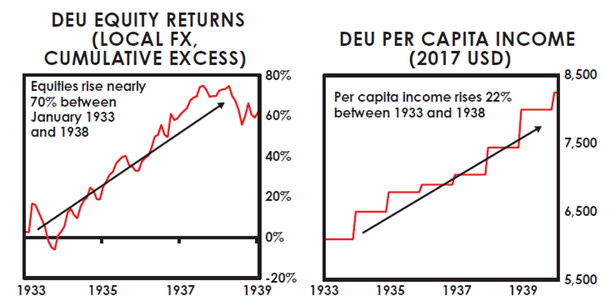
As for the economic effects of these policies, when Hitler came to power in 1933 the unemployment rate was 25 percent. By 1938 it was nil. Per capita income increased by 22 percent in the five years after Hitler took power, and real growth averaged over 8 percent per year between 1934 and 1938. As shown in the following charts, German equities rallied nearly 70 percent in a steady trend between 1933 and 1938, until the onset of the hot war.
독일과 일본
독일은 제1차 세계대전 이후 막대한 배상금 부채를 떠안고 있었지만, 1929년 무렵에는 상당한 채무 경감과 1930년까지 독일에서 외국군 철수를 규정한 영 플랜(Young Plan)을 통해 그 굴레에서 벗어나기 시작하고 있었다. 그러나 세계 대공황은 독일을 강타하여 실업률이 거의 25퍼센트에 달했고, 대규모 파산과 광범위한 빈곤이 발생했다. 일반적인 경우처럼, 좌파 포퓰리스트(공산주의자)와 우파 포퓰리스트(파시스트) 사이의 투쟁이 벌어졌다. 주요 포퓰리스트/파시스트 지도자였던 아돌프 히틀러는 국가적 굴욕의 분위기를 이용해 민족주의적 열광을 조성했으며, 베르사유 조약과 그것을 강요한 국가들을 적으로 규정했다. 그는 25개 조항의 민족주의 강령을 만들고 그 주위로 지지를 결집시켰다. 내부 갈등과 질서 회복에 대한 열망에 대응하여, 히틀러는 1933년 1월 총리로 임명되었으며, 공산주의자들을 두려워한 산업가들로부터 나치당에 대한 대규모 지지를 얻었다. 두 달 후, 나치당은 독일 의회(라이히스타크)에서 가장 많은 지지와 가장 많은 의석을 획득했다.
히틀러는 더 이상의 배상금 지급을 거부하고, 국제연맹을 탈퇴했으며, 1934년에 독일에 대한 권위주의적 통제를 장악했다. 총리와 대통령의 두 직책을 겸임하면서 그는 국가의 최고 지도자가 되었다. 민주주의 국가들에는 항상 지도자들이 특별 권한을 장악할 수 있도록 허용하는 몇몇 법률들이 존재하는데, 히틀러는 그것들을 모두 장악했다. 그는 바이마르 헌법 제48조를 발동하여 많은 시민권을 종료시키고 공산주의자들의 정치적 반대를 억압했으며, 의회와 대통령의 승인 없이 법률을 통과시킬 수 있도록 허용하는 수권법(Enabling Act)의 통과를 강행했다. 그는 어떤 반대에도 무자비했다—신문과 방송사를 검열하거나 장악했고, 비밀경찰(게슈타포)을 창설하여 반대 세력을 색출하고 분쇄했으며, 유대인들의 시민권을 박탈했고, 개신교 교회의 재정을 장악했으며, 그에게 반대하는 교회 지도자들을 체포했다. 아리아 인종의 우월성을 선언하며, 그는 비(非)아리아인들이 정부에서 봉사하는 것을 금지했다.
히틀러는 대규모 재정 및 통화 부양 프로그램과 결합하여 동일한 권위주의적/파시스트적 접근 방식으로 독일 경제를 재건했다. 그는 국유 기업을 민영화하고 기업 투자를 장려했으며, 아리아계 독일인들의 생활수준을 공격적으로 끌어올렸다. 예를 들어, 그는 자동차를 저렴하고 접근 가능하게 만들기 위해 폭스바겐을 설립했고, 아우토반 건설을 지시했다. 그는 은행들로 하여금 국채를 매입하도록 강제함으로써 이렇게 크게 증가한 정부 지출을 재원 조달했다. 이렇게 발생한 부채는 기업들의 수익과 중앙은행(라이히스방크)이 부채를 화폐화함으로써 상환되었다. 이러한 재정 정책들은 대체로 히틀러의 목표를 달성하는 데 효과적으로 작동했다. 이는 자국 통화로 차입하고 자국의 부채와 재정적자를 증가시키는 것이, 차입된 자금이 생산성을 높이고 부채 상환을 충분히 감당할 수 있는 현금 흐름을 창출하는 투자에 사용된다면 매우 생산적일 수 있다는 또 하나의 사례이다. 설령 그것이 부채 서비스 비용의 100퍼센트를 충당하지 못하더라도, 국가의 경제적 목표를 달성하는 데 매우 비용 효율적일 수 있다.
이러한 정책들의 경제적 효과를 보면, 히틀러가 1933년에 집권했을 당시 실업률은 25퍼센트였다. 1938년에는 그것이 거의 0에 가까웠다. 히틀러 집권 후 5년 동안 1인당 소득은 22퍼센트 증가했으며, 1934년부터 1938년 사이 실질 성장률은 연평균 8퍼센트를 넘었다. 다음의 도표들에서 보이듯이, 독일 주식은 1933년부터 1938년까지, 본격적인 전쟁이 시작되기 전까지, 꾸준한 추세 속에서 거의 70퍼센트 상승했다.
In 1935, Hitler began to build the military, making military service compulsory for Aryans. Germany’s military spending increased much faster than any other country because the German economy needed more resources to fuel itself and it intended to use its military power to seize them.
Like Germany, Japan was also hit exceptionally hard by the depression and became more autocratic in response. Japan was especially vulnerable to the depression because, as an island nation without adequate natural resources, it relied on exports for income to import necessities. When its exports fell by around 50 percent between 1929 and 1931, Japan was economically devastated. In 1931, Japan went broke—i.e., it was forced to draw down its gold reserves, abandon the gold standard, and float its currency, which depreciated it so greatly that Japan ran out of buying power. These terrible conditions and large wealth gaps led to fighting between the left and the right. By 1932, there was a massive upsurge in right-wing nationalism and militarism, in the hope that order and economic stability could be forcibly restored. Japan set out to get the natural resources (e.g., oil, iron, coal, and rubber) and human resources (i.e., slave labor) it needed by seizing them from other countries, invading Manchuria in 1931 and spreading out through China and Asia. As with Germany, it could be argued that Japan’s path of military aggression to get needed resources was more cost-effective than relying on classic trading and economic practices. In 1934, there was severe famine in parts of Japan, causing even more political turbulence and reinforcing the right-wing, militaristic, nationalistic, and expansionistic movement.
In the years that followed, Japan’s top-down fascist command economy grew stronger, building a military-industrial complex to protect its existing bases in East Asia and northern China and support its excursions into other countries. As was also the case in Germany, while most Japanese companies remained privately held, their production was controlled by the government.
What is fascism? Consider the following three big choices that a country has to make when selecting its approach to governance:
1) bottom-up (democratic) or top-down (autocratic) decision making, 2) capitalist or communist (with socialist in the middle) ownership of production, and 3) individualistic (which treats the well-being of the individual with paramount importance) or collectivist (which treats the well-being of the whole with paramount importance). Pick the one from each category that you believe preferred approach. Fascism is autocratic, capitalist, and collectivist.
Fascists believe that top-down autocratic leadership, in which the government directs the production of privately held companies such that individual gratification is subordinated to national success, is the best way to make the country and its people wealthier and more powerful.
1935년에 히틀러는 군대를 재건하기 시작했으며, 아리아인들에게 군 복무를 의무화했다. 독일의 군사 지출은 다른 어떤 나라보다 훨씬 빠르게 증가했는데, 이는 독일 경제가 스스로를 가동하기 위해 더 많은 자원을 필요로 했고, 그것들을 군사력을 통해 확보할 의도가 있었기 때문이다.
독일과 마찬가지로, 일본도 대공황의 타격을 유난히 심하게 받았고 그에 대한 대응으로 더욱 권위주의적으로 변했다. 일본은 특히 대공황에 취약했는데, 충분한 천연자원을 보유하지 못한 섬나라였기 때문에 필수품을 수입하기 위한 소득을 수출에 의존하고 있었기 때문이다. 1929년부터 1931년 사이에 수출이 약 50퍼센트 감소하자, 일본 경제는 심각한 타격을 입었다. 1931년에 일본은 파산 상태에 이르렀다—즉, 금 보유고를 소진해야 했고, 금본위제를 포기했으며, 통화를 변동환율제로 전환했는데, 그 결과 통화가 크게 평가절하되어 일본은 구매력을 상실했다. 이러한 끔찍한 상황과 심각한 빈부 격차는 좌파와 우파 사이의 충돌로 이어졌다. 1932년 무렵에는 질서와 경제적 안정을 강제로 회복할 수 있다는 희망 속에서 우익 민족주의와 군국주의가 대대적으로 급부상했다. 일본은 필요한 천연자원(예: 석유, 철, 석탄, 고무)과 인적 자원(즉, 노예 노동력)을 다른 나라들로부터 빼앗아 확보하고자 했으며, 1931년에 만주를 침공하고 중국과 아시아 전역으로 확장해 나갔다. 독일의 경우와 마찬가지로, 필요한 자원을 확보하기 위한 일본의 군사적 침략 경로는 전통적인 무역 및 경제 관행에 의존하는 것보다 더 비용 효율적이었다고 주장될 수 있다. 1934년에는 일본 일부 지역에서 심각한 기근이 발생하여 정치적 혼란이 더욱 심화되었고, 우익적이고 군국주의적이며 민족주의적이고 팽창주의적인 움직임을 더욱 강화했다.
그 이후 몇 년 동안 일본의 상명하달식 파시스트 지휘 경제는 더욱 강화되었으며, 동아시아와 중국 북부의 기존 기지를 보호하고 다른 나라들로의 진출을 지원하기 위해 군산복합체를 구축했다. 독일의 경우와 마찬가지로, 대부분의 일본 기업들은 여전히 민간 소유로 남아 있었지만, 그들의 생산은 정부에 의해 통제되었다.
파시즘이란 무엇인가? 한 국가가 통치 방식을 선택할 때 내려야 하는 다음의 세 가지 중요한 선택을 고려해보라.
- 상향식(민주적) 의사결정인가, 하향식(권위주의적) 의사결정인가,
- 생산 수단의 소유가 자본주의인가, 공산주의인가(사회주의는 그 중간에 위치),
- 개인의 복지를 최우선으로 여기는 개인주의인가, 전체의 복지를 최우선으로 여기는 집단주의인가.
각 범주에서 자신이 선호하는 접근 방식을 선택해보라. 파시즘은 권위주의적이고, 자본주의적이며, 집단주의적이다.
파시스트들은, 정부가 민간 소유 기업들의 생산을 지휘하여 개인적 만족이 국가적 성공에 종속되도록 하는 상명하달식 권위주의 지도체제가 국가와 국민을 더 부유하고 더 강력하게 만드는 최선의 방법이라고 믿는다.
The US and the Allies
In the US, debt problems became ruinous for American banks after 1929, which curtailed their lending around the world, hurting international borrowers. At the same time, the depression created weak demand, which led to a collapse of US imports and other countries’ sales to the US. As incomes weakened, demand fell and more credit problems occurred in a self-reinforcing downward economic spiral. The US responded by turning protectionist to safeguard jobs, raising tariffs via the passage of the Smoot-Hawley Tariff Act in 1930, which further depressed economic conditions in other countries.
* Raising tariffs to protect domestic businesses and jobs during bad economic times is common, but it leads to reduced efficiency because production does not occur where it can be done most efficiently. Ultimately, tariffs contribute to greater global economic weakness, as tariff wars cause the countries that impose them to lose exports. Tariffs do, however, benefit the entities that are protected by them, and they can create political support for the leaders who impose them.
The Soviet Union had yet to recover from its devastating 1917–22 revolution and civil war, a lost war to Germany, a costly war with Poland, and a famine in 1921, and it was wracked by political purges and economic hardships throughout the 1930s. China also suffered from civil war, poverty, and a famine in 1928–30. So, when things worsened in 1930 and tariffs began, bad conditions became desperate conditions in those countries.
To make matters worse, there were droughts in the US and in the Soviet Union in the 1930s. * Harmful acts of nature (e.g., droughts, floods, and plagues) often cause periods of great economic hardship that when combined with other adverse conditions lead to periods of great conflict. In combination with extreme government policies, millions died in the USSR. At the same time, internal political fighting and fears of Nazi Germany led to purges of hundreds of thousands of people who were accused of spying and shot without trials.
* Deflationary depressions are debt crises caused by there not being enough money in the hands of debtors to service their debts. They inevitably lead to the printing of money, debt restructurings, and government spending programs that increase the supply of, and reduce the value of, money and credit. The only question is how long it takes for government officials to make this move.
In the case of the US, it took three and a half years from the crash in October 1929 until President Franklin D. Roosevelt’s March 1933 actions. In Roosevelt’s first 100 days in office, he created several massive government spending programs that were paid for by big tax increases and big budget deficits financed by debt that the Federal Reserve monetized. He instituted jobs programs, unemployment insurance, Social Security supports, and labor- and union friendly programs. After his 1935 tax bill, then popularly called the “Soak the Rich Tax,” the top marginal income tax rate for individuals rose to 75 percent (versus as low as 25 percent in 1930). By 1941, the top personal tax rate was 81 percent, and the top corporate tax rate was 31 percent, having started at 12 percent in 1930. Roosevelt also imposed a number of other taxes. Despite all of these taxes and the pickup in the economy that helped raise tax revenue, budget deficits increased from around 1 percent of GDP to about 4 percent of GDP because the spending increases were so large. From 1933 until the end of 1936 the stock market returned over 200 percent, and the economy grew at a blistering average real rate of about 9 percent.
미국과 연합국
미국에서는 1929년 이후 부채 문제가 미국 은행들에 치명적인 타격을 주었고, 이는 그들의 전 세계 대출을 축소하게 만들었으며 국제 차입자들에게 피해를 주었다. 동시에 대공황은 수요를 약화시켰고, 이는 미국의 수입과 다른 국가들의 대미(對美) 수출 붕괴로 이어졌다. 소득이 약화되자 수요가 감소했고, 더 많은 신용 문제가 발생하면서 자기강화적인 하향 경제 악순환이 전개되었다. 미국은 일자리를 보호하기 위해 보호무역주의로 방향을 전환했고, 1930년 스무트-홀리 관세법(Smoot-Hawley Tariff Act)을 통과시켜 관세를 인상했으며, 이는 다른 나라들의 경제 상황을 더욱 악화시켰다.
- 나쁜 경제 상황에서 국내 기업과 일자리를 보호하기 위해 관세를 인상하는 것은 흔한 일이지만, 그것은 생산이 가장 효율적으로 이루어질 수 있는 곳에서 이루어지지 않게 만들기 때문에 효율성을 떨어뜨린다. 궁극적으로 관세는 세계 경제의 약화를 심화시킨다. 왜냐하면 관세 전쟁은 그것을 부과한 국가들로 하여금 수출을 잃게 만들기 때문이다. 그러나 관세는 보호를 받는 집단들에게 이익을 주며, 그것을 부과한 지도자들에게 정치적 지지를 만들어낼 수 있다.
소련은 1917~22년의 파괴적인 혁명과 내전, 독일에 패한 전쟁, 폴란드와의 비용이 많이 든 전쟁, 그리고 1921년의 기근으로부터 아직 회복하지 못한 상태였고, 1930년대 내내 정치적 숙청과 경제적 곤궁에 시달렸다. 중국 역시 내전과 빈곤, 그리고 1928~30년의 기근으로 고통받고 있었다. 따라서 1930년에 상황이 악화되고 관세가 시작되자, 나쁜 상황은 그 국가들에서 절망적인 상황으로 변했다.
설상가상으로, 1930년대에는 미국과 소련에서 가뭄이 발생했다. * 가뭄, 홍수, 전염병과 같은 자연의 해로운 작용은 종종 심각한 경제적 고난의 시기를 초래하며, 그것이 다른 불리한 조건들과 결합될 때 큰 갈등의 시기로 이어진다. 극단적인 정부 정책과 결합하여, 소련에서는 수백만 명이 사망했다. 동시에 내부 정치적 갈등과 나치 독일에 대한 공포는 스파이로 고발된 수십만 명에 대한 숙청으로 이어졌으며, 그들은 재판도 없이 총살되었다.
- 디플레이션성 대공황은 채무자들이 자신의 부채를 상환할 충분한 돈을 보유하지 못함으로써 발생하는 부채 위기이다. 그것은 필연적으로 화폐 발행, 부채 재조정, 그리고 화폐와 신용의 공급을 늘리고 그 가치를 낮추는 정부 지출 프로그램으로 이어진다. 유일한 문제는 정부 관리들이 이러한 조치를 취하기까지 얼마나 오래 걸리느냐이다.
미국의 경우, 1929년 10월의 붕괴 이후 프랭클린 D. 루스벨트 대통령이 1933년 3월에 조치를 취하기까지 3년 반이 걸렸다. 루스벨트는 취임 후 첫 100일 동안 여러 대규모 정부 지출 프로그램을 도입했으며, 이는 대폭적인 세금 인상과 연방준비제도(Federal Reserve)가 화폐화한 부채로 조달된 대규모 재정 적자를 통해 재원 마련되었다. 그는 일자리 프로그램, 실업 보험, 사회보장 제도, 그리고 노동자 및 노동조합 친화적 정책들을 도입했다. 1935년 그의 세제 개편 법안—당시 “부자세(Soak the Rich Tax)”라고 불렸다—이 통과된 이후, 개인 최고 한계소득세율은 75퍼센트로 상승했다(1930년에는 25퍼센트까지 낮았었다). 1941년에는 개인 최고 세율이 81퍼센트, 법인 최고 세율이 31퍼센트에 이르렀는데, 이는 1930년에 각각 12퍼센트에서 출발한 것이었다. 루스벨트는 이 외에도 여러 다른 세금을 부과했다. 이 모든 세금과 경제 회복으로 인한 세수 증가에도 불구하고, 지출 증가가 매우 컸기 때문에 재정 적자는 GDP의 약 1퍼센트에서 약 4퍼센트로 증가했다. 1933년부터 1936년 말까지 주식시장은 200퍼센트 이상 상승했으며, 경제는 연평균 약 9퍼센트의 매우 높은 실질 성장률을 기록했다.
In 1936, the Federal Reserve tightened money and credit to fight inflation and slow an overheating economy, which caused the fragile US economy to fall back into recession and the other major economies to weaken with it, further raising tensions within and between countries.
Meanwhile in Europe, the conflict in Spain between the populists of the left (the communists) and the populists of the right (the fascists) flared into the brutal Spanish Civil War. Right-wing Franco, with the support of Hitler, succeeded in purging left-wing opposition in Spain.
* During periods of severe economic distress and large wealth gaps, there are typically revolutionarily large redistributions of wealth. When done peacefully these are achieved through large tax increases on the rich and big increases in the supply of money that devalue debtors’ claims, and when done violently they are achieved by forced asset confiscations. In the US and the UK, while there were redistributions of wealth and political power, capitalism and democracy were maintained. In Germany, Japan, Italy, and Spain they were not.
* Before there is a shooting war there is usually an economic war. As is also typical, before all-out wars are declared there is about a decade of economic, technological, geopolitical, and capital wars, during which the conflicting powers intimidate each other, testing the limits of each other’s power. While 1939 and 1941 are known as the official starts of the wars in Europe and the Pacific, the conflicts really began about 10 years before that. In addition to the economically motivated conflicts within countries and the political shifts that arose from them, all of these countries faced increased external economic conflicts as they fought for greater shares of a shrinking economic pie. Because power, and not law, rules international relations, Germany and Japan became more expansionist and increasingly began to test the UK, the US, and France in the competition over resources and influence over territories.
Before going on to describe the hot war, I want to elaborate on the common tactics used when economic and capital tools are weaponized.
They have been and still are:
1. Asset freezes/seizures: Preventing an enemy/rival from using or selling foreign assets they rely on. These measures can range from asset freezes for targeted groups in a country (e.g., the current US sanctions of the Iranian Revolutionary Guard or the initial US asset freeze against Japan in World War II) to more severe measures like unilateral debt repudiation or outright seizures of a country’s assets (e.g., some top US policy makers have been talking about not paying our debts to China).
2. Blocking capital markets access: Preventing a country from accessing their own or another country’s capital markets (e.g., in 1887 Germany banned the purchase of Russian securities and debt to impede Russia’s military buildup; the US is now threatening to do this to China).
3. Embargoes/blockades: Blocking trade in goods and/or services in one’s own country and in some cases with neutral third parties for the purpose of weakening the targeted country or preventing it from getting essential items (e.g., the US’s oil embargo on Japan and cutting off its ships’ access to the Panama Canal in World War II) or blocking exports from the targeted country to other countries, thus cutting off their income (e.g., France’s blockade of the UK in the Napoleonic Wars).
If you’re interested in seeing how these tactics have been applied from 1600 until now, they are available at economicprinciples.org
1936년에 연방준비제도는 인플레이션을 억제하고 과열된 경제를 둔화시키기 위해 통화와 신용을 긴축했다. 그 결과 취약했던 미국 경제는 다시 불황으로 빠져들었고, 다른 주요 경제들도 함께 약화되었으며, 이는 국가 내부와 국가 간의 긴장을 더욱 고조시켰다.
한편 유럽에서는 스페인에서 좌파 포퓰리스트(공산주의자)와 우파 포퓰리스트(파시스트) 사이의 갈등이 잔혹한 스페인 내전으로 번졌다. 히틀러의 지원을 받은 우파의 프랑코는 스페인에서 좌파 반대 세력을 숙청하는 데 성공했다.
- 심각한 경제적 고통과 큰 빈부 격차가 존재하는 시기에는, 일반적으로 혁명적 규모의 부의 재분배가 일어난다. 그것이 평화적으로 이루어질 경우에는 부자에 대한 대규모 세금 인상과 채권자의 청구권 가치를 떨어뜨리는 대규모 통화 공급 확대를 통해 달성된다. 반대로 폭력적으로 이루어질 경우에는 강제적인 자산 몰수를 통해 이루어진다. 미국과 영국에서는 부와 정치적 권력의 재분배가 있었지만, 자본주의와 민주주의는 유지되었다. 그러나 독일, 일본, 이탈리아, 스페인에서는 그렇지 않았다.
- 총격전이 벌어지기 전에 대개 경제 전쟁이 먼저 존재한다. 또한 전면전이 공식적으로 선언되기 전에는, 대략 10년 정도의 경제, 기술, 지정학, 자본 전쟁이 선행하는 것이 일반적이다. 이 기간 동안 서로 대립하는 강대국들은 상대를 위협하며 서로의 힘의 한계를 시험한다. 1939년과 1941년이 각각 유럽과 태평양 전쟁의 공식적 시작으로 알려져 있지만, 실제 갈등은 그보다 약 10년 전부터 시작되었다. 국가 내부에서 경제적 동기에 의해 발생한 갈등과 그로 인해 일어난 정치적 변화에 더해, 이들 모든 국가는 줄어드는 경제적 파이를 더 크게 차지하기 위해 경쟁하면서 외부적 경제 갈등의 증가에 직면했다. 국제 관계를 지배하는 것은 법이 아니라 힘이기 때문에, 독일과 일본은 더욱 팽창주의적으로 변했고, 자원과 영토에 대한 영향력을 둘러싼 경쟁에서 영국, 미국, 프랑스를 점점 더 시험하기 시작했다.
본격적인 전쟁을 설명하기 전에, 경제 및 자본 수단이 무기화될 때 사용되는 일반적인 전술들에 대해 설명하고자 한다.
그 전술들은 과거에도 그러했으며 지금도 여전히 다음과 같다.
- 자산 동결/압류: 적 또는 경쟁자가 의존하고 있는 해외 자산을 사용하거나 매각하지 못하도록 하는 것. 이러한 조치는 특정 집단에 대한 자산 동결(예: 현재 미국이 이란 혁명수비대에 가하는 제재나, 제2차 세계대전 당시 일본에 대한 초기 미국의 자산 동결)에서부터, 일방적인 채무 불이행 선언이나 국가 자산의 전면적 압류와 같은 더 강력한 조치(예: 일부 미국 고위 정책 입안자들이 중국에 대한 미국의 채무를 상환하지 말자고 언급한 사례)에 이르기까지 다양하다.
- 자본 시장 접근 차단: 한 국가가 자국 또는 타국의 자본 시장에 접근하지 못하도록 하는 것(예: 1887년 독일이 러시아의 군비 증강을 저지하기 위해 러시아 증권과 채권의 매입을 금지한 사례; 현재 미국이 중국에 대해 이를 위협하고 있다).
- 금수 조치/봉쇄: 표적 국가를 약화시키거나 필수 물자를 획득하지 못하게 하기 위해 자국 내에서의 상품 및/또는 서비스의 교역을 차단하거나, 경우에 따라 중립적인 제3국과의 교역을 차단하는 것(예: 제2차 세계대전 당시 미국의 대일(對日) 석유 금수 조치와 파나마 운하에 대한 일본 선박의 접근 차단), 또는 표적 국가의 수출을 다른 국가들로 차단하여 그들의 소득을 끊는 것(예: 나폴레옹 전쟁 당시 프랑스의 영국 봉쇄).
1600년부터 지금까지 이러한 전술들이 어떻게 적용되어 왔는지에 관심이 있다면, economicprinciples.org에서 확인할 수 있다.
THE HOT WAR BEGINS
In November 1937, Hitler secretly met with his top officials to announce his plans for German expansion to gain resources and bring together the Aryan race. Then he put them into action, first annexing Austria and then seizing a part of what was then Czechoslovakia that contained oil resources. Europe and the US watched warily, not wanting to get drawn into another war so soon after the devastation of World War I.
As with all wars, the unknowns were far greater than the knowns because a) rival powers go into wars only when their powers are roughly comparable (otherwise it would be stupidly suicidal for the obviously weaker power) and b) there are way too many possible actions and reactions to anticipate. The only thing that is known at the outset of a hot war is that it will probably be extremely painful and possibly ruinous. As a result, smart leaders typically go into them only if the other side has pushed them into a position of either fighting or losing by backing down. For the Allies, that moment came on September 1, 1939, when Germany invaded Poland.
Germany looked unstoppable; in short order it captured Denmark, Norway, the Netherlands, Belgium, Luxembourg, and France, and strengthened its alliances with Japan and Italy, which had common enemies and were ideologically aligned. By seizing territory rapidly (e.g., oil-rich Romania), Hitler’s army was able to conserve its existing oil resources and gain new ones quickly. The thirst for, and acquisition of, natural resources remained a major driver of the Nazi war machine as it pushed its campaigns into Russia and the Middle East. War with the Soviets was inevitable; the only question was when. Although Germany and the USSR had signed a non-aggression pact, Germany invaded Russia in June 1941, which put Germany in an extremely costly war on two fronts.
In the Pacific in 1937, Japan expanded its occupation of China, brutally taking control of Shanghai and Nanking, killing an estimated 200,000 Chinese civilians and disarmed combatants in the capture of Nanking alone. While the US remained isolationist, it did provide Chiang Kai-shek’s government with fighter planes and pilots to counter the Japanese, putting a toe in the war. Conflicts between the US and Japan began to flare. A Japanese soldier struck the US consul, John Moore Allison, in the face in Nanking and Japanese fighter planes sank a US gunship.
본격적인 전쟁이 시작되다
1937년 11월, 히틀러는 자원 확보와 아리아 인종의 통합을 위한 독일의 팽창 계획을 발표하기 위해 고위 관리들과 비밀리에 회동했다. 그리고 그는 이를 실행에 옮겼다. 먼저 오스트리아를 병합했고, 이어 당시 체코슬로바키아였던 지역 중 석유 자원을 포함한 일부를 점령했다. 유럽과 미국은 제1차 세계대전의 참상이 채 가시기도 전에 또 다른 전쟁에 휘말리고 싶지 않았기 때문에 경계심을 가지고 이를 지켜보았다.
모든 전쟁과 마찬가지로, 알려진 것보다 알려지지 않은 것이 훨씬 더 많았다. 그 이유는 a) 경쟁 강대국들은 대체로 힘이 비슷할 때에만 전쟁에 들어가기 때문이며(그렇지 않다면 명백히 약한 쪽에게는 어리석고 자살적인 일이 될 것이다), b) 예측하기에는 가능한 행동과 반응의 경우의 수가 너무 많기 때문이다. 본격적인 전쟁의 시작 시점에 확실히 알 수 있는 유일한 것은 그것이 아마도 극도로 고통스럽고, 어쩌면 파멸적일 것이라는 점이다. 그 결과, 현명한 지도자들은 보통 상대가 자신들을 싸우거나 물러서서 패배하는 선택지로 몰아넣었을 때에만 전쟁에 들어간다. 연합국에게 그러한 순간은 1939년 9월 1일, 독일이 폴란드를 침공했을 때 찾아왔다.
독일은 멈출 수 없어 보였다. 단기간에 덴마크, 노르웨이, 네덜란드, 벨기에, 룩셈부르크, 프랑스를 점령했으며, 공통의 적을 가지고 이념적으로도 aligned되어 있던 일본과 이탈리아와의 동맹을 강화했다. 히틀러의 군대는 영토를 신속히 점령함으로써(예: 석유가 풍부한 루마니아) 기존의 석유 자원을 보존하고 새로운 자원을 빠르게 확보할 수 있었다. 천연자원에 대한 갈망과 그 확보는 러시아와 중동으로 전선을 확장하는 동안에도 나치 전쟁 기계를 움직이는 주요 동력이었다. 소련과의 전쟁은 피할 수 없는 일이었다. 문제는 언제였을 뿐이다. 독일과 소련은 불가침 조약을 체결했음에도 불구하고, 1941년 6월 독일은 러시아를 침공했고, 그로 인해 독일은 두 전선에서 막대한 비용이 드는 전쟁에 휘말리게 되었다.
한편 태평양에서는 1937년 일본이 중국 점령을 확대하여 상하이와 난징을 잔혹하게 장악했으며, 난징 점령 과정에서만 약 20만 명에 달하는 중국 민간인과 무장 해제된 전투원을 살해했다. 미국은 여전히 고립주의 노선을 유지하고 있었지만, 일본에 맞서기 위해 장제스 정부에 전투기와 조종사들을 제공하며 전쟁에 발을 들여놓기 시작했다. 미국과 일본 사이의 갈등은 점차 고조되기 시작했다. 일본 군인은 난징에서 미국 영사 존 무어 앨리슨을 얼굴을 때렸고, 일본 전투기들은 미국의 포함을 격침시켰다.
In November 1940, Roosevelt won re-election after campaigning on the promise to keep the US out of the war, even though the US was already taking economic actions to protect its interests, especially in the Pacific, using economic supports to help countries it sympathized with and economic sanctions against those it did not. Earlier in 1940, Secretary of War Henry Stimson had initiated aggressive economic sanctions against Japan, culminating in the Export Control Act of 1940. In mid-1940, the US moved the US Pacific Fleet to Hawaii. In October, the US ramped up the embargo, restricting “all iron and steel to destinations other than Britain and nations of the Western Hemisphere.” The plan was to cut Japan off from resources in order to force them to retreat from most of the areas they had taken over.
In March 1941, Congress passed the Lend-Lease Act, which allowed the US to lend or lease war supplies to the nations it deemed to be acting in ways that were “vital to the defense of the United States,” which included Great Britain, the Soviet Union, and China. Helping the Allies was good for the US both geopolitically and economically because it made a lot of money selling weapons, food, and other items to these soon-to-be-allied countries who were struggling to maintain production while waging war. But its motivations weren’t entirely mercenary. Great Britain was running out of money (i.e., gold), so the US allowed them to postpone payment until after the war (in some cases waiving payment entirely). Although not an outright declaration of war, Lend-Lease effectively ended the United States’ neutrality.
* When countries are weak, opposing countries take advantage of their weaknesses to obtain gains. France, the Netherlands, and Great Britain all had colonies in Asia. Overstretched by the fighting in Europe, they were unable to defend them against the Japanese. Starting in September 1940, Japan invaded several colonies in Southeast Asia, beginning with French Indochina, adding what it called the Southern Resource Zone to its Greater East Asia Co-Prosperity Sphere. In 1941, Japan seized oil reserves in the Dutch East Indies.
This Japanese territorial expansion was a threat to the US’s own Pacific ambitions. In July and August 1941, Roosevelt responded by freezing all Japanese assets in the United States, closing the Panama Canal to Japanese ships, and embargoing oil and gas exports to Japan. This cut off three-fourths of Japan’s trade and 80 percent of its oil. Japan calculated that it would run out of oil in two years. This put Japan in the position of having to choose between backing down or attacking the US.
On December 7 and 8, 1941, Japan launched coordinated attacks on US military forces at Pearl Harbor and in the Philippines. This marked the beginning of the declared war in the Pacific, which brought the US into the war in Europe too. While Japan didn’t have a widely recognized plan to win the war, the most optimistic Japanese leaders believed that the US would lose because it was fighting a war on two fronts and because its individualistic/capitalist political system was inferior to Japan’s and Germany’s authoritarian/fascist systems with their command military-industrial complexes. They also believed that they had a greater willingness to endure and die for their country, which is a big driver of which side wins. * In war one’s ability to withstand pain is even more important than one’s ability to inflict pain.
1940년 11월, 루스벨트는 미국을 전쟁에 끌어들이지 않겠다는 공약을 내세워 재선에 성공했다. 그러나 그 시점에도 미국은 이미 자국의 이익을 보호하기 위해, 특히 태평양 지역에서, 경제적 조치를 취하고 있었다. 미국은 자신이 동조하는 국가들에는 경제적 지원을 제공하고, 동조하지 않는 국가들에는 경제 제재를 가했다. 1940년 초, 전쟁장관 헨리 스팀슨은 일본에 대해 공격적인 경제 제재를 시작했으며, 이는 1940년 수출통제법(Export Control Act of 1940)으로 정점에 이르렀다. 1940년 중반, 미국은 태평양 함대를 하와이로 이동시켰다. 10월에는 금수 조치를 강화하여 “영국과 서반구 국가들을 제외한 모든 목적지로의 철과 강철” 수출을 제한했다. 그 계획은 일본이 점령한 대부분의 지역에서 철수하도록 만들기 위해 자원 공급을 차단하는 것이었다.
1941년 3월, 의회는 무기대여법(Lend-Lease Act)을 통과시켰다. 이는 미국이 “미국의 방위에 필수적”이라고 판단되는 방식으로 행동하는 국가들—영국, 소련, 중국을 포함한—에 전쟁 물자를 대여하거나 임대할 수 있도록 허용하는 법이었다. 연합국을 지원하는 것은 지정학적으로도, 경제적으로도 미국에 이익이었다. 전쟁을 수행하면서 생산을 유지하려 애쓰던 이들 국가에 무기, 식량, 기타 물자를 판매함으로써 많은 돈을 벌 수 있었기 때문이다. 그러나 그 동기가 전적으로 상업적이었던 것은 아니다. 영국은 자금(즉, 금)을 거의 소진한 상태였기 때문에, 미국은 전쟁 이후까지 지불을 연기하도록 허용했고(경우에 따라서는 아예 면제하기도 했다). 이는 공식적인 전쟁 선포는 아니었지만, 무기대여법은 사실상 미국의 중립을 끝내는 조치였다.
- 국가가 약해지면, 적대국들은 그 약점을 이용하여 이익을 취한다. 프랑스, 네덜란드, 영국은 모두 아시아에 식민지를 가지고 있었다. 유럽에서의 전쟁으로 과도하게 소모된 이들 국가는 일본에 맞서 그 식민지들을 방어할 수 없었다. 1940년 9월부터 일본은 프랑스령 인도차이나를 시작으로 동남아시아의 여러 식민지를 침공했고, 이를 자신들이 말한 ‘대동아공영권(Greater East Asia Co-Prosperity Sphere)’의 남방 자원지대(Southern Resource Zone)에 편입시켰다. 1941년에는 일본이 네덜란드령 동인도의 석유 자원을 장악했다.
이러한 일본의 영토 확장은 미국의 태평양 지역 구상에 대한 위협이었다. 1941년 7월과 8월, 루스벨트는 미국 내 모든 일본 자산을 동결하고, 일본 선박의 파나마 운하 통과를 차단하며, 일본에 대한 석유와 가스 수출을 금지하는 조치로 대응했다. 이는 일본 무역의 4분의 3과 석유의 80퍼센트를 차단하는 효과를 가져왔다. 일본은 2년 내에 석유가 고갈될 것이라고 계산했다. 이는 일본을 물러설 것인가, 아니면 미국을 공격할 것인가의 선택지 앞에 놓이게 했다.
1941년 12월 7일과 8일, 일본은 진주만과 필리핀에 있는 미국 군사력에 대해 동시다발적인 공격을 감행했다. 이는 태평양에서 공식적으로 선포된 전쟁의 시작이었으며, 동시에 미국을 유럽 전쟁에도 참전하게 만들었다. 일본은 전쟁에서 승리하기 위한 널리 인정된 명확한 계획을 가지고 있지는 않았지만, 가장 낙관적인 일본 지도자들은 미국이 두 전선에서 전쟁을 치르고 있었고, 개인주의적/자본주의적 정치 체제가 일본과 독일의 권위주의적/파시스트적 체제 및 지휘 통제된 군산복합체보다 열등하다고 믿었기 때문에 미국이 패배할 것이라고 생각했다. 또한 그들은 자국민이 더 큰 고통을 견디고 국가를 위해 죽을 의지를 가지고 있다고 믿었는데, 이는 어느 쪽이 승리하는지를 결정하는 중요한 요소이다. * 전쟁에서는 고통을 가하는 능력보다 고통을 견디는 능력이 더 중요하다.
WARTIME ECONOMIC POLICIES
Just as it is worth noting what classic economic war tactics are, it is also worth noting what classic wartime economic policies are within countries. These include government controls on just about everything as the country shifts its resources from profit making to war making—e.g., the government determines a) what items are allowed to be produced, b) what items can be bought and sold in what amounts (rationing), c) what items can be imported and exported, d) prices, wages, and profits, e) access to one’s own financial assets, and f) the ability to move one’s own money out of the country. Because wars are expensive, classically the government g) issues lots of debt that is monetized, h) relies on non-credit money such as gold for international transactions because its credit is not accepted, i) governs more autocratically, j) imposes various types of economic sanctions on enemies, including cutting off their access to capital, and k) experiences enemies imposing these sanctions on them.
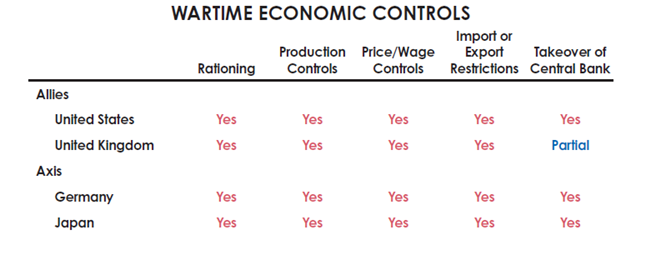
When the US entered the European and Pacific wars after the attack on Pearl Harbor, classic wartime economic policies were put in place in most countries by leaders whose more autocratic approaches were broadly supported by their populations. The following table shows those economic controls in each of the major countries.
전시 경제 정책
전형적인 경제 전쟁 전술이 무엇인지 주목할 가치가 있는 것처럼, 각국 내부에서의 전형적인 전시 경제 정책이 무엇인지 주목하는 것도 가치가 있다. 이러한 정책에는 국가가 자원을 이윤 창출에서 전쟁 수행으로 전환함에 따라 거의 모든 것에 대한 정부의 통제가 포함된다. 예를 들어, 정부는 a) 어떤 품목이 생산될 수 있는지, b) 어떤 품목이 어떤 양으로 사고팔릴 수 있는지(배급), c) 어떤 품목이 수입·수출될 수 있는지, d) 가격, 임금, 이윤, e) 개인의 금융 자산에 대한 접근, f) 자국의 자금을 해외로 이동시킬 수 있는 능력 등을 결정한다. 전쟁은 비용이 많이 들기 때문에, 전통적으로 정부는 g) 대량의 부채를 발행하고 이를 화폐화하며, h) 신용이 받아들여지지 않기 때문에 국제 거래에서 금과 같은 비신용 화폐에 의존하고, i) 더 권위주의적으로 통치하며, j) 적국에 대해 자본 접근을 차단하는 것을 포함한 다양한 경제 제재를 가하고, k) 적으로부터 이러한 제재를 받기도 한다.
진주만 공격 이후 미국이 유럽과 태평양 전쟁에 참전했을 때, 보다 권위주의적인 접근을 취한 지도자들에 의해 전형적인 전시 경제 정책이 대부분의 국가에서 시행되었으며, 이러한 접근은 그들 인구로부터 광범위한 지지를 받았다. 아래의 표는 주요 국가들 각각에서 시행된 그러한 경제 통제를 보여준다.
The market movements during the hot war years were heavily affected by both government controls and how countries did in battles as the odds of winning and losing changed. The next table shows the controls over markets and capital flows that were put in place by the major countries during the war years.
본격적인 전쟁 기간 동안의 시장 움직임은 정부의 통제와 각국이 전투에서 어떤 성과를 거두었는지—즉 승패의 가능성이 어떻게 변화했는지—에 의해 크게 영향을 받았다. 다음 표는 전쟁 기간 동안 주요 국가들이 시행한 시장 및 자본 흐름에 대한 통제를 보여준다.
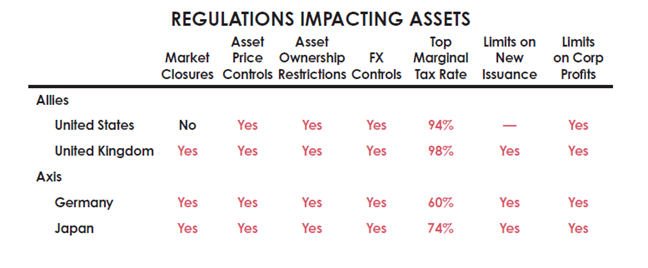
Stock market closures were common in a number of countries, leaving investors in stocks stuck without access to their capital. I should also note that money and credit were not commonly accepted between non-allied countries during the war because of a justifiable wariness about whether the currency would have any value. As noted earlier, gold—or, in some cases, silver or barter—is the coin of the realm during wars. At such times, prices and capital flows are typically controlled, so it is difficult to say what the real prices of many things are.
Because losing wars typically leads to a total wipeout of wealth and power, movements of those stock markets that remained open in the war years were largely driven by how countries did in key battles as these results shifted the probability of victory or defeat for each side. For example, German equities outperformed at the beginning of World War II as Germany captured territory and established military dominance, while they underperformed after Allied powers like the US and the UK turned the tide of the war. After the 1942 Battle of Midway, Allied equities rallied almost continuously until the end of the war, while Axis equities were flat or down. As shown, both the German and Japanese stock markets were closed at the end of the war, didn’t reopen for around five years, and were virtually wiped out when they did, while US stocks were extremely strong.
여러 국가에서 주식시장 폐쇄는 흔한 일이었으며, 그 결과 주식에 투자한 투자자들은 자본에 접근하지 못한 채 묶여 있었다. 또한 전쟁 기간 동안에는 해당 통화가 실제로 가치가 있을지에 대한 정당한 불신 때문에 비동맹 국가들 사이에서 화폐와 신용이 일반적으로 받아들여지지 않았다는 점도 언급해야 한다. 앞서 언급했듯이, 전쟁 시기에는 금—혹은 경우에 따라 은이나 물물교환—이 통용 화폐이다. 이러한 시기에는 가격과 자본 이동이 일반적으로 통제되므로, 많은 것들의 실제 가격이 무엇인지 말하기 어렵다.
전쟁에서 패배하는 것은 대개 부와 권력의 완전한 소멸로 이어지기 때문에, 전쟁 기간 동안 개장 상태를 유지했던 주식시장들의 움직임은 각국이 주요 전투에서 어떤 성과를 거두었는지—그리고 그 결과가 각 진영의 승패 확률을 어떻게 변화시켰는지—에 크게 좌우되었다. 예를 들어, 제2차 세계대전 초기에 독일이 영토를 점령하고 군사적 우위를 확립했을 때 독일 주식은 상대적으로 우수한 성과를 보였으나, 미국과 영국과 같은 연합국이 전세를 뒤집은 이후에는 부진한 성과를 보였다. 1942년 미드웨이 해전 이후, 연합국 주식은 전쟁이 끝날 때까지 거의 지속적으로 상승한 반면, 추축국 주식은 보합이거나 하락했다. 보이는 바와 같이, 전쟁이 끝날 무렵 독일과 일본의 주식시장은 모두 폐쇄되었고, 약 5년 동안 재개장하지 않았으며, 재개장했을 때는 사실상 거의 전부가 소멸된 상태였다. 반면 미국 주식은 매우 강한 모습을 보였다.

Protecting one’s wealth in times of war is difficult, as normal economic activities are curtailed, traditionally safe investments are not safe, capital mobility is limited, and high taxes are imposed when people and countries are fighting for their survival. Protecting the wealth of those who have it is not a priority relative to the need to redistribute wealth to get it to where it is needed most. As for investing, sell out of all debt and buy gold because wars are financed by borrowing and printing money, which devalues debt and money, and because there is a justifiable reluctance to accept credit.
전쟁 시기에 자신의 부를 보호하는 것은 어렵다. 정상적인 경제 활동이 축소되고, 전통적으로 안전하다고 여겨졌던 투자도 더 이상 안전하지 않으며, 자본 이동이 제한되고, 사람들과 국가들이 생존을 위해 싸우는 상황에서는 높은 세금이 부과되기 때문이다. 부를 가진 사람들의 자산을 보호하는 것은, 그것을 가장 필요로 하는 곳으로 재분배해야 할 필요성에 비해 우선순위가 아니다. 투자에 관해서 말하자면, 모든 부채 자산을 처분하고 금을 매수하라. 전쟁은 차입과 화폐 발행으로 자금을 조달하며, 이는 부채와 화폐의 가치를 떨어뜨리기 때문이고, 또한 신용을 받아들이는 것에 대해 정당한 꺼림이 존재하기 때문이다.
CONCLUSION
Every world power has its time in the sun, thanks to the uniqueness of their circumstances and the nature of their character and culture (e.g., they have the essential elements of a strong work ethic, smarts, discipline, education, etc.), but they all eventually decline. Some do so more gracefully than others, with less trauma, but they nevertheless decline. Traumatic declines can lead to some of the worst periods in history, when big fights over wealth and power prove extremely costly both economically and in human lives.
Still, the cycle needn’t transpire this way if countries in their rich and powerful stages stay productive, earn more than they spend, make the system work well for most of their populations, and figure out ways of creating and sustaining win-win relationships with their most significant rivals. A number of empires and dynasties have sustained themselves for hundreds of years, and the United States, at 245 years old, has proven itself to be one of the longest-lasting.
결론
모든 세계 강대국은 각자의 상황의 독특함과 그들의 성격 및 문화의 본질(예: 강한 근로 윤리, 지적 능력, 규율, 교육 등 필수 요소들) 덕분에 전성기를 누리는 시기가 있다. 그러나 결국에는 모두 쇠퇴한다. 어떤 나라는 다른 나라들보다 더 점잖고 덜 충격적인 방식으로 쇠퇴하지만, 그럼에도 불구하고 쇠퇴한다. 충격적인 쇠퇴는 역사상 최악의 시기들로 이어질 수 있으며, 그때에는 부와 권력을 둘러싼 거대한 싸움이 경제적으로도, 인명 측면에서도 극도로 큰 비용을 초래한다.
그럼에도 불구하고, 부유하고 강력한 단계에 있는 국가들이 생산성을 유지하고, 지출보다 더 많이 벌며, 제도가 인구의 대다수에게 잘 작동하도록 만들고, 가장 중요한 경쟁자들과 윈윈 관계를 창출하고 유지하는 방법을 찾아낸다면, 그 순환이 반드시 이런 식으로 전개될 필요는 없다. 여러 제국과 왕조는 수백 년 동안 자신들을 유지해 왔으며, 245년의 역사를 가진 미국은 가장 오래 지속된 국가들 중 하나임을 입증해 왔다.
'記錄' 카테고리의 다른 글
| Ontology: How Philosophy Shaped the Ontology at the Heart of Modern AI (1) | 2026.03.12 |
|---|---|
| “The World Is More Equal Than You Think” (0) | 2026.02.27 |
| Anthropic: "인류는 빠르게 멸종을 향해 달려가고 세상 모두가 그걸 원하니 나는 남은 시간 동안 시나 쓰면서 놀겠습니다." (1) | 2026.02.12 |
| Agentic AI: '창조적 파괴'의 서막 (1) | 2026.02.06 |
| Palantir: “세상은 위험하고, 누군가는 그 더러운 문제를 해결해야 한다” (1) | 2026.01.29 |